Posts

Is homeopathic medicine is steroid

In general, no. Homeopathic medicines are not steroid medicines. Here's the difference: Homeopathic medicines are made by repeatedly diluting substances according to homeopathic principles. Most commercially prepared homeopathic remedies contain either extremely tiny amounts of the original substance or none that can be detected. Steroids (such as prednisolone, dexamethasone, or hydrocortisone) are conventional drugs that reduce inflammation and suppress the immune system. However, there is an important exception: Some products sold as "homeopathic" or "herbal" remedies have been found to be illegally adulterated with steroids or other prescription drugs. This is uncommon but has happened in some countries, especially with unregulated products. These hidden steroids can cause side effects if taken for long periods.

Advantages of homeopathy

Homeopathy is a system of alternative medicine developed by Samuel Hahnemann in the late 18th century. People who use homeopathy often point to several perceived advantages. Here are commonly cited advantages of homeopathy: Highly diluted remedies Homeopathic remedies are prepared in very small doses, and supporters believe this reduces the risk of side effects compared with many conventional medicines. Individualized treatment Practitioners often consider the whole person — physical symptoms, emotional state, lifestyle, and overall constitution — rather than focusing only on one disease. Non-invasive treatment Remedies are typically taken as tablets, drops, or liquids, so treatment usually does not involve injections or surgical procedures. Widely used for chronic complaints Some people seek homeopathy for long-term issues such as allergies, migraines, skin conditions, or joint pain. May feel more holistic Consultations can be longer and more detailed, which some patients value b...

Psora and sycosis

“Psora” and “Sycosis” are terms mainly used in homeopathy, especially from the theory of chronic miasms proposed by Samuel Hahnemann. Here’s the basic idea: 1. Psora In homeopathic theory, Psora is considered the fundamental miasm (an underlying chronic tendency toward disease). It is associated with: Itching skin conditions (eczema, dry rashes) Allergies Digestive troubles Anxiety, restlessness General weakness or hypersensitivity Homeopathic practitioners describe psora as linked to functional disturbances — when the body is not working optimally but there may not be major structural disease. 2. Sycosis Sycosis is another chronic miasm, traditionally associated with overgrowth or excess. It is associated with: Warts Skin thickening Excessive discharge (chronic sinus, mucus) Joint stiffness Growths like cysts, polyps Tendency toward recurring inflammation Homeopathic theory describes sycosis as involving accumulation, excess tissue growth, or chronic recurring conditions. Simp...

Law of homeopathy

Homeopathy is based on a few core principles developed by Samuel Hahnemann, who createdthe system of Homeopathy in the late 1700s. The main “laws” are: 1. Law of Similars (“Like cures like”) The idea: A substance that causes symptoms in a healthy person may treat similar symptoms in a sick person when given in a specially prepared dose. Example: Cutting onions causes watery eyes So homeopathy uses Allium cepa preparations for cold symptoms with watery eyes. 2. Law of Minimum Dose The idea: The smaller the dose, the stronger the healing effect (after repeated dilution and preparation). Homeopathic remedies are often diluted many times. Example: 6C 30C 200C potency scales. 3. Law of Individualization The idea: Treatment is chosen for the individual person, not just the disease. Example: Two people with headaches may receive different remedies depending on: Personality Sleep pattern Appetite Other symptoms. 4. Single Remedy Principle The idea: Use one remedy at a time rathe...

Comparison of allopathic and homeopathic

Here’s a straightforward comparison of allopathic medicine and homeopathic medicine. Basic difference Feature Allopathic Medicine Homeopathic Medicine Definition Conventional modern medicine used in hospitals and clinics Alternative medicine based on the principle of “like cures like” Developed by Modern medical science Samuel Hahnemann in the late 1700s Scientific basis Based on biology, chemistry, clinical trials Based on highly diluted substances; scientific evidence is limited Goal Diagnose and directly treat disease Stimulate the body’s self-healing response (homeopathic theory) How treatment works Allopathic medicine Uses treatments such as: Antibiotics for bacterial infections Surgery Vaccines Prescription medications Examples: Paracetamol for fever Ibuprofen for pain/inflammation Works by targeting a known biological mechanism. Homeopathic medicine Uses extremely diluted preparations. Examples often sold as homeopathic remedies: Arnica montana Nux vomica Theory: A subs...

Scope of homeopathic

What is homeopathy? Homeopathy is an alternative medicine system developed by Samuel Hahnemann. Practitioners use highly diluted remedies based on the principle of “like cures like.” Career paths in homeopathy are; You can work as: Private clinic practitioner Assistant in existing clinics Teaching (if you complete formal qualifications) Alternative medicine consultant Medicine manufacturing / distribution companies Potential advantages Lower setup cost than opening many other healthcare practices In places like Pakistan and India, there is still public demand in some communities Can eventually run your own clinic Challenges Income depends heavily on reputation and patient trust Scientific evidence for many homeopathic treatments remains controversial compared with conventional medicine Regulations and recognition vary by country It can take years to build a stable practice Income (varies a lot) Roughly depends on: Your qualification Location Whether you run your own clinic...

What does Microsoft power point mean, definition from techopedia

 What is Microsoft Power Point? Difintion from Techopedia Definition - What does Microsoft PowerPoint mean? Microsoft Power Point is powerful presentation software developed by Microsoft. It is a standard component of the company's Microsoft Office suite software, and is bundled together with Word.,Excel and other Office productivity tools. The program uses slides to convey information rich multimedia. The term "slide" refers to the slide projector, which this software effectively replaces. Guidelines for an effective presentation: Reference Computer Literacy COURSE GUIDE Associate Degree in Education/B.Ed. (Hons) Elementary 2011 provide the following guidelines to the Trainee Teachers for these assignments: *Remember that Power Point helps to 'visualize ideas', communicate key points, and main formation 'memorable'. Do not use presentations to dump data. *The presentation should be to the point, focusing on actual purpose. *The presentation should have a ...

The Use Of Weblogs In Education and Blog categories

 Category - A 1. What is a blog? Weblogs are personal web pages written in chronological order and maintained through a specific software that helps their administrators. Weblogs, commonly referred to as blogs, are similar to an electronic journal or diary. The writer, known as a blogger, makes periodic entries, sometimes as frequently as a few times a day. 2. How will you find the blog of your interest? What distinguishes a blog from other online publications is the periodic updates, usually displayed on the homepage in reverse chronological order: new entries appear at the top of the page and older ones are archived according to date. Ask your students for other ways blogs are different from websites. 3. What kinds of subjects do bloggers write bout? Blogs can be on any subject. Discuss with your students the subjects of blogs they have read, or ask them to imagine a blog subject that would interest them. 4. How can you find blogs that interest you? You can use online sea...

Structural Model of Antibodies

Image
  Structural Model of Antibodies  Antibodies are immune system-related proteins called immunoglobulins. Each antibody consists of four polypeptides, two heavy chains and two light chains joined to form a "Y" shaped molecule. The amino acid sequence in the tips of the "Y" varies greatly among different antibodies. This variable region, composed of 110-130 amino acids, give the antibody its specificity for binding antigen. The variable region includes the ends of the light and heavy chains. The constant region determines the mechanism used to destroy antigen. Antibodies are divided into five major classes, IgM, IgG, IgA, IgD, and IgE, based on their constant region structure and immune function.  Role of Memory Cells in Immunity Neither the killer T-cells nor the B-cells just die off after they kill the pathogen. When their job is done, they leave behind memory cells. These memory cells are cells that stay behind and watch for the pathogen. If they find one...

Third line of Defence (the specific Defence)

Image
 Third Line of Defense (The Specific Defense) If a pathogen still manages to cross first and second line of defenses and get into your bloodstream, you're not beaten yet! All cell membranes have protein coats that line the outside of them. Early on, when you were still developing as a baby, your body begins learning which cells belong to you and which don't. Now, your developed body has a good idea of whether cells are pathogens or not. This is accomplished by two defense mechanisims, cell mediated and humoral.T lymphocytes or T cells, along with macrophages, oversee the Cell mediated response, while the B lymphocytes or B cells take charge of the humoral Response. Monocytes develop from stem cells in the bone marrow. They then go into blood, where they circulate and then migrate into tissues. In the tissue they further mature into macrophages. Monocytes and macrophages play important roles in the immune defence and inflammation.Lymphocytes are one of the five kinds of white bl...

Cardio vascular disorders

Image
Cardio vascular disorders, lymphatic system, open heart surgery    Cardiovascular Disorders Many disorders are associated with the circulatory system. Some of the significant are the following.  Thrombosis and Embolism Thrombus is a Greek word which means blood clot. It is formed by the aggregation of platelets inside the vessels. The disorder in which a person generates a thrombus in a vessel is called thrombosis. A thrombus in a blood vessel is very painful. A thrombus in a large blood vessel decreases blood flow through that vessel but in a small blood vessel it may completely stop the blood flow resulting in the death of tissue supplied by that vessel. Risk of thrombosis increases in certain conditions like atrial fibrillation, heart valve replacement, a recent heart attack, extended periods of inactivity. Sometimes genetic factors make a person more prone to thrombosis. Generally bed ridden patients and people like barbers who keep standing for hours as part of th...

Path of blood through Pulmonary and systemitic circulation

Image
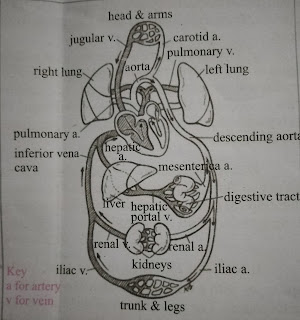
  Path of Blood through Pulmonary and Systemic Circulation When a heart contracts and forces blood into the blood vessels, there is a certain path that the blood follows through the body. The blood moves through pulmonary circulation and then continues on through systemic circulation.  Pulmonary and systemic are the two circuits in the two-circuit system of higher animals with closed circulatory systems. Humans and other mammals have two-circuit circulatory systems: one circuit is for pulmonary circulation (circulation to the lungs, pulmo = lungs), and the other circuit is for systemic circulation (the rest of the body). As each atrium and ventricle contract, blood is pumped into certain major blood vessels, and from there, continues through the circulatory system. Exchange of Materia The most important function of blood circulatory system is to transport oxygen and nutrients to the cells of the tissue and remove the metabolic waste products from the tissues and transpor...

Disorders related to digestive system and food habits

 Disorders related to digestive system and food habits Ulcer Destruction of the gastric or intestinal mucosal lining of the stomach by hydrochloric acid is a direct cause of peptic ulcer. Infection with the bacterium Helicobacter pylori is thought to play an important role in causing both gastric and duodenal ulcers. Helicobacter pylori may be transmitted from person to person through contaminated food and water Injury of the gastric mucosal lining, and weakening of the mucous defenses are also responsible for gastric ulcers. Excess secretion of hydrochloric acid, genetic predisposition, and psychological stress important contributing factors in the formation and worsening of duodenal ulcers. Another major cause of ulcers is the chronic use of anti- inflammatory medications, such as aspirin. Cigarette smoking is also an important cause of ulcer formation and ulcer treatment failure. The stomach defends itself from hydrochloric acid and pepsin by creating a mucus coating (that s...

Mechanical and chemical digestion in the oral cavity

Image
 Mechanical and Chemical Digestion in the Oral cavity The gastrointestinal tract starts in the oral cavity where your teeth grind and chew food, breaking it into small manageable pieces. This chewing process, known as mastication, is temporalis dependent upon powerful muscles muscle (masseter and temporalis), as well as smaller muscles that permit fine control; they move the mandible (lower jawbone) against the upper jaw and enable crushing of relatively hard food. muscle. Mastication causes exocrine glands under the tongue and in the back called saliva which performs two essential functions. It moistens and compacts the chewed food so your tongue can roll it into a ball (bolus) and push it masseter to the back of your mouth for swallowing and easy passage through the pharynx and In addition, saliva contains digestive enzymes (e.g. salivary amylase) which begin the breakdown of carbohydrates. Mastication and saliva secretion work in harmony:chewing increases the surface area of ...