Posts

Third line of Defence (the specific Defence)

Image
 Third Line of Defense (The Specific Defense) If a pathogen still manages to cross first and second line of defenses and get into your bloodstream, you're not beaten yet! All cell membranes have protein coats that line the outside of them. Early on, when you were still developing as a baby, your body begins learning which cells belong to you and which don't. Now, your developed body has a good idea of whether cells are pathogens or not. This is accomplished by two defense mechanisims, cell mediated and humoral.T lymphocytes or T cells, along with macrophages, oversee the Cell mediated response, while the B lymphocytes or B cells take charge of the humoral Response. Monocytes develop from stem cells in the bone marrow. They then go into blood, where they circulate and then migrate into tissues. In the tissue they further mature into macrophages. Monocytes and macrophages play important roles in the immune defence and inflammation.Lymphocytes are one of the five kinds of white bl...

Cardio vascular disorders

Image
Cardio vascular disorders, lymphatic system, open heart surgery    Cardiovascular Disorders Many disorders are associated with the circulatory system. Some of the significant are the following.  Thrombosis and Embolism Thrombus is a Greek word which means blood clot. It is formed by the aggregation of platelets inside the vessels. The disorder in which a person generates a thrombus in a vessel is called thrombosis. A thrombus in a blood vessel is very painful. A thrombus in a large blood vessel decreases blood flow through that vessel but in a small blood vessel it may completely stop the blood flow resulting in the death of tissue supplied by that vessel. Risk of thrombosis increases in certain conditions like atrial fibrillation, heart valve replacement, a recent heart attack, extended periods of inactivity. Sometimes genetic factors make a person more prone to thrombosis. Generally bed ridden patients and people like barbers who keep standing for hours as part of th...

Path of blood through Pulmonary and systemitic circulation

Image
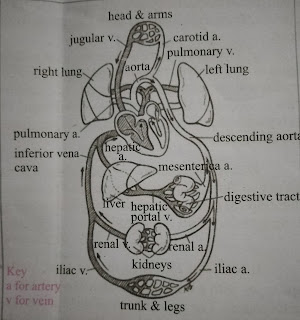
  Path of Blood through Pulmonary and Systemic Circulation When a heart contracts and forces blood into the blood vessels, there is a certain path that the blood follows through the body. The blood moves through pulmonary circulation and then continues on through systemic circulation.  Pulmonary and systemic are the two circuits in the two-circuit system of higher animals with closed circulatory systems. Humans and other mammals have two-circuit circulatory systems: one circuit is for pulmonary circulation (circulation to the lungs, pulmo = lungs), and the other circuit is for systemic circulation (the rest of the body). As each atrium and ventricle contract, blood is pumped into certain major blood vessels, and from there, continues through the circulatory system. Exchange of Materia The most important function of blood circulatory system is to transport oxygen and nutrients to the cells of the tissue and remove the metabolic waste products from the tissues and transpor...

Disorders related to digestive system and food habits

 Disorders related to digestive system and food habits Ulcer Destruction of the gastric or intestinal mucosal lining of the stomach by hydrochloric acid is a direct cause of peptic ulcer. Infection with the bacterium Helicobacter pylori is thought to play an important role in causing both gastric and duodenal ulcers. Helicobacter pylori may be transmitted from person to person through contaminated food and water Injury of the gastric mucosal lining, and weakening of the mucous defenses are also responsible for gastric ulcers. Excess secretion of hydrochloric acid, genetic predisposition, and psychological stress important contributing factors in the formation and worsening of duodenal ulcers. Another major cause of ulcers is the chronic use of anti- inflammatory medications, such as aspirin. Cigarette smoking is also an important cause of ulcer formation and ulcer treatment failure. The stomach defends itself from hydrochloric acid and pepsin by creating a mucus coating (that s...

Mechanical and chemical digestion in the oral cavity

Image
 Mechanical and Chemical Digestion in the Oral cavity The gastrointestinal tract starts in the oral cavity where your teeth grind and chew food, breaking it into small manageable pieces. This chewing process, known as mastication, is temporalis dependent upon powerful muscles muscle (masseter and temporalis), as well as smaller muscles that permit fine control; they move the mandible (lower jawbone) against the upper jaw and enable crushing of relatively hard food. muscle. Mastication causes exocrine glands under the tongue and in the back called saliva which performs two essential functions. It moistens and compacts the chewed food so your tongue can roll it into a ball (bolus) and push it masseter to the back of your mouth for swallowing and easy passage through the pharynx and In addition, saliva contains digestive enzymes (e.g. salivary amylase) which begin the breakdown of carbohydrates. Mastication and saliva secretion work in harmony:chewing increases the surface area of ...

Food in the small intestine and absorption of nutrients in small intestine and structure of large intestine

 Food in the Small Intestine As the contents of the stomach become thoroughly liquefied, they pass into the duodenum, the first segment (about 10 of the small intestine. Food typically takes 4-5 hours to pass through the stomach into the duodenum, the first part of the small intestine. After being churned and mixed with digestive juices in the stomach, food chyme moves slowly into the folds of the small intestine through the pyloric sphincter or valve. The small intestine (or small bowel) is the longest section of the digestive tract (approx 17 feet) and is divided into three segments: the duodenum, jejunum and ileum, each of which performs different digestive functions. Chyme from the stomach is propelled through the small intestine by peristalsis.  Functions of the Small Intestine The small intestine is where most chemical digestion takes place; peptides (complex chains of protein molecules) are broken down into amino acids; lipids (fats) are broken down into fatty acids and...

Distinguishing Characteristics of Birds and types of birds and class Mammals

 Distinguishing Characteristics of Birds They are homoiothermic i.e. warm blooded animals because they can maintain their body temperature. The body is covered by different coloured feathers which are epidermal exoskeleton. Body is fusiform (streamlined) to allow better movement in air with less resistance. Fore limbs are modified into wings for flight.They have adapted a bipedal life and hind limbs are used for walking on land. The aquatic birds posses webbed feet. Skin is without epidermal glands except for uropygial gland present at the base of tail. Bones of the birds are hollow having air spaces which make them light in weight. Sternum is well developed in to a keel which not only helps in cutting the air during flight but also provide additional area for the attachment of muscles. Jaws are without tecth and are modified in the form of a beak. Digestive system has a crop to store the food and a gizzard to grindit. Heart is four chambered with two auricles and two ventricles. A...